
Possum and bird proofing in Newcastle and the Hunter
Possums and most birds are protected wildlife in New South Wales, so this is not a poison-and-be-done job. The lasting fix is proofing: wait for the animal to leave of its own accord, then close the way it got in. This page helps you work out what is actually up there, and shows how exclusion keeps a roof quiet for good.
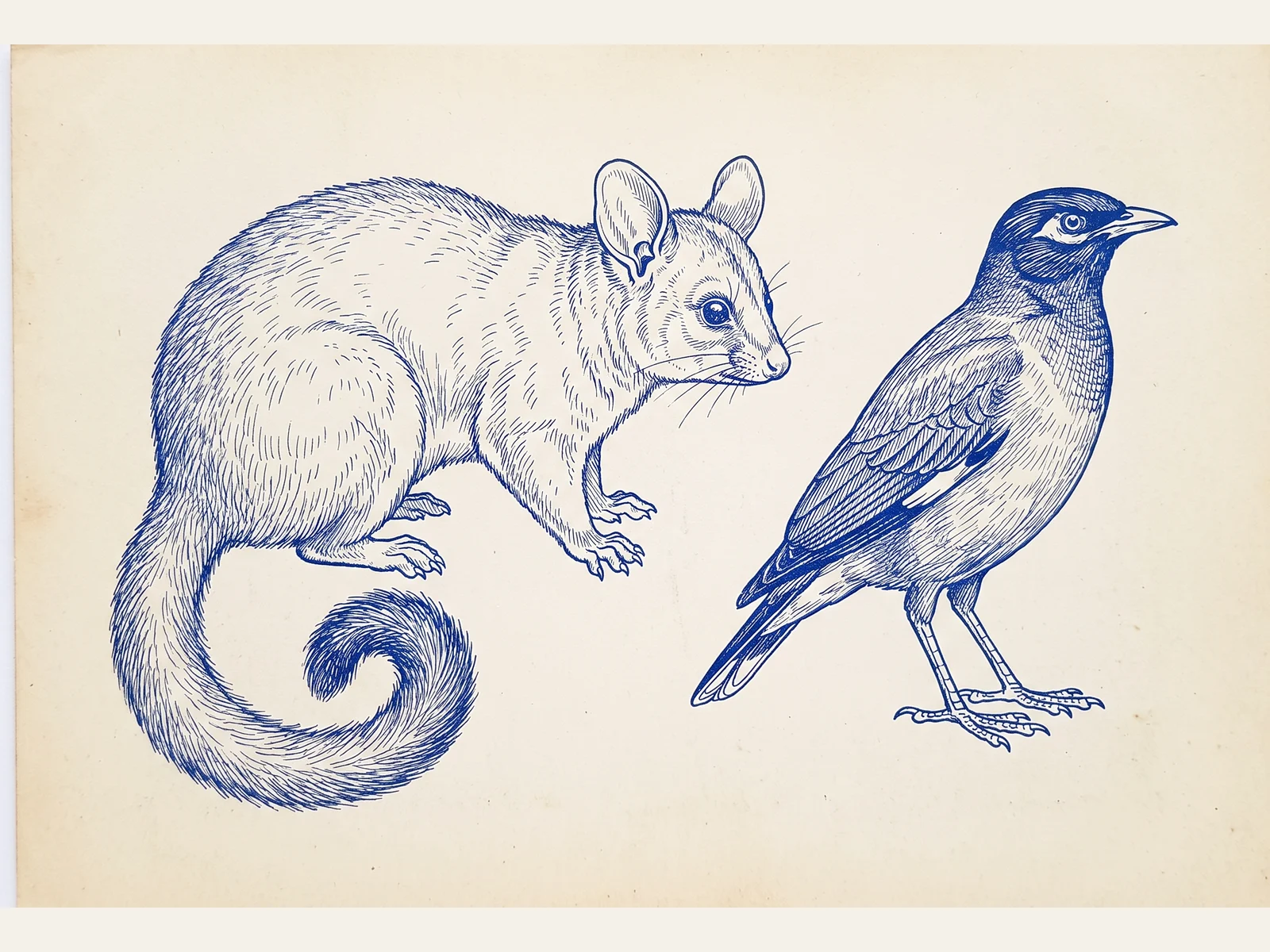
Possum, or rat? Listen first
Most people who land on this page followed a noise in the ceiling, and half the time the noise is not what they think. It matters more than usual here, because a possum and a rat are opposite jobs: one is protected and gets proofed out, the other gets baited or trapped. The sound tells you which, before anyone climbs a ladder.
Heavy, and awake at dusk
It sounds like a small person walking, not a scatter of feet. You hear it leave around dusk to feed and come back before light. A sudden guttural hiss in the roof is a brushtail marking its patch, and it is unmistakable once you have heard it.
Light, and busy at midnight
Quick, scratchy, and it travels: you can almost trace the run across the ceiling. Add chewed packets in the pantry or rice-grain droppings and it is rodents, which is a different page and a different method.
If the ceiling reads as rats, start on rodent control instead. If you are genuinely not sure, describe the sound and the time of night in the enquiry and a licensed technician will tell you which it is before booking anything.

Why the fix is proofing, not poison
The common brushtail possum is protected under NSW law. It cannot be poisoned, and it cannot be trapped and driven off to a park somewhere: the rules require a trapped possum to be released close to where it was caught, on the same property, at night. Move it further and you either break the law or send it back the next evening. This is not red tape for its own sake. A relocated possum usually dies, and the empty roof it left just draws the next one in.
So removal on its own never works. What works is exclusion. You wait until the animal leaves to feed at dusk, close the gap it uses, and give it somewhere better to sleep nearby so it stops trying to break back in. Done properly, that is permanent. Birds work the same way: the introduced pest birds get proofed off their roosts, native birds are left alone, and nothing is poisoned.
The one rule we never bend is that no animal gets sealed inside. A possum shut in a roof void is a welfare problem and, within a week, a smell you will not forget. Confirming the space is empty before anything is closed is the whole craft of this job.
Any trapping and release of a possum is separately licensed wildlife work, arranged only where proofing genuinely cannot solve it.
How a possum gets proofed out
Four steps, in this order. Skip the first and you seal an animal in; skip the last and it is back inside a fortnight.
Find every entry, and the one in use
Brushtails climb: an overhanging branch onto a Federation roof, a lifted ridge cap, a broken eaves sheet, the gap under a solar panel. The inspection maps them all and works out which one is the current door, usually from the rub marks and droppings that build up at a used entry.
Wait for it to leave, or fit a one-way door
The clean way is to close up at night once the possum has gone out to feed. Where the timing is awkward, a one-way flap over the entry lets it out but not back in. Either way, nothing is sealed until we are certain the space is empty.
Close the gaps for good
Timber and steel mesh over the eaves gaps, the ridge line capped, branches cut back off the roof, mesh guards around the solar panels. Possums re-use the same routes for years, so a properly closed roof stays closed.
Offer a better bed nearby
A nest box in a tree close by gives the possum somewhere to move into instead of fighting to get back into your roof. It is the difference between a proofing job that holds and one that turns into a nightly wrestling match at the eaves.
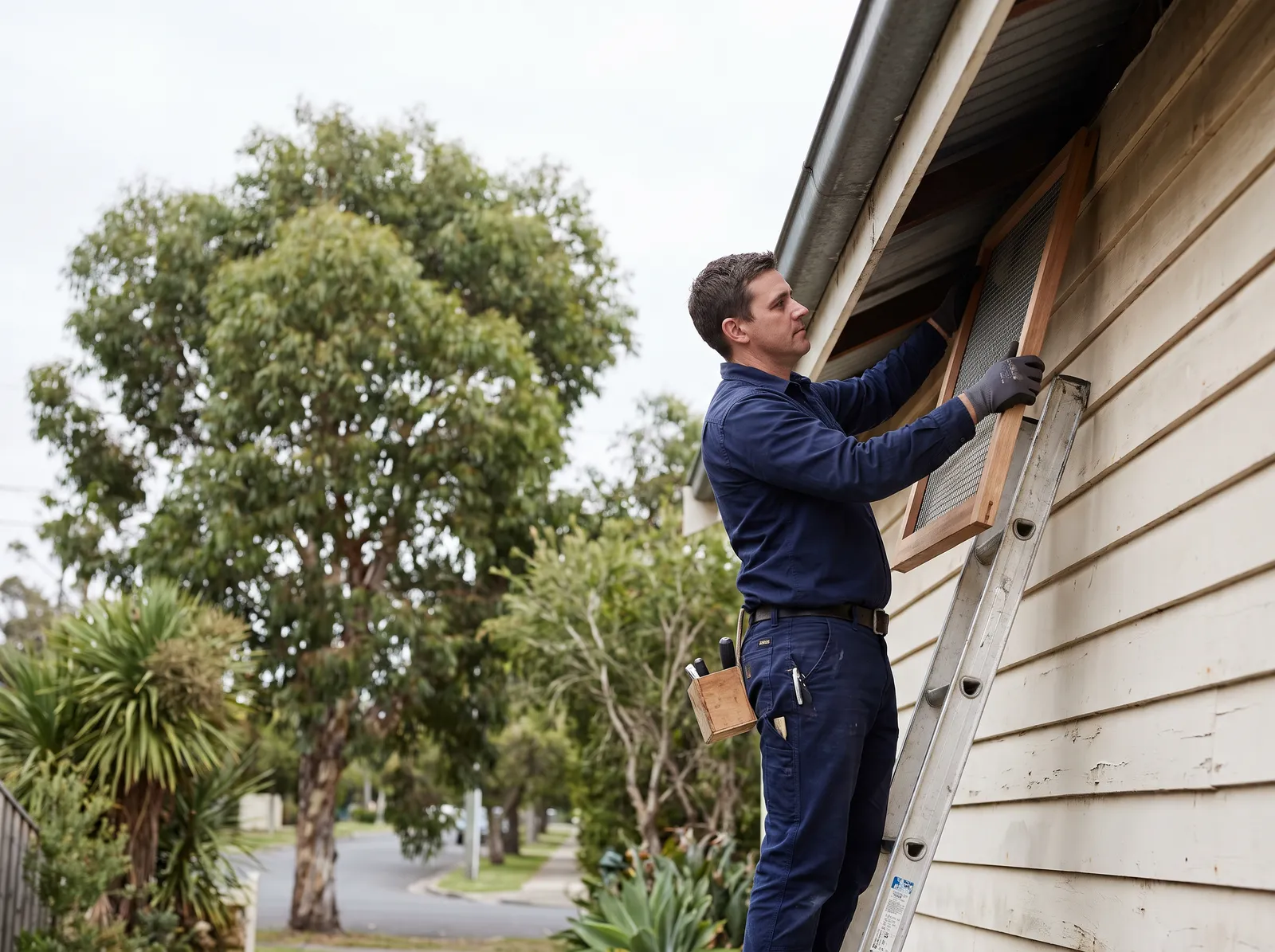
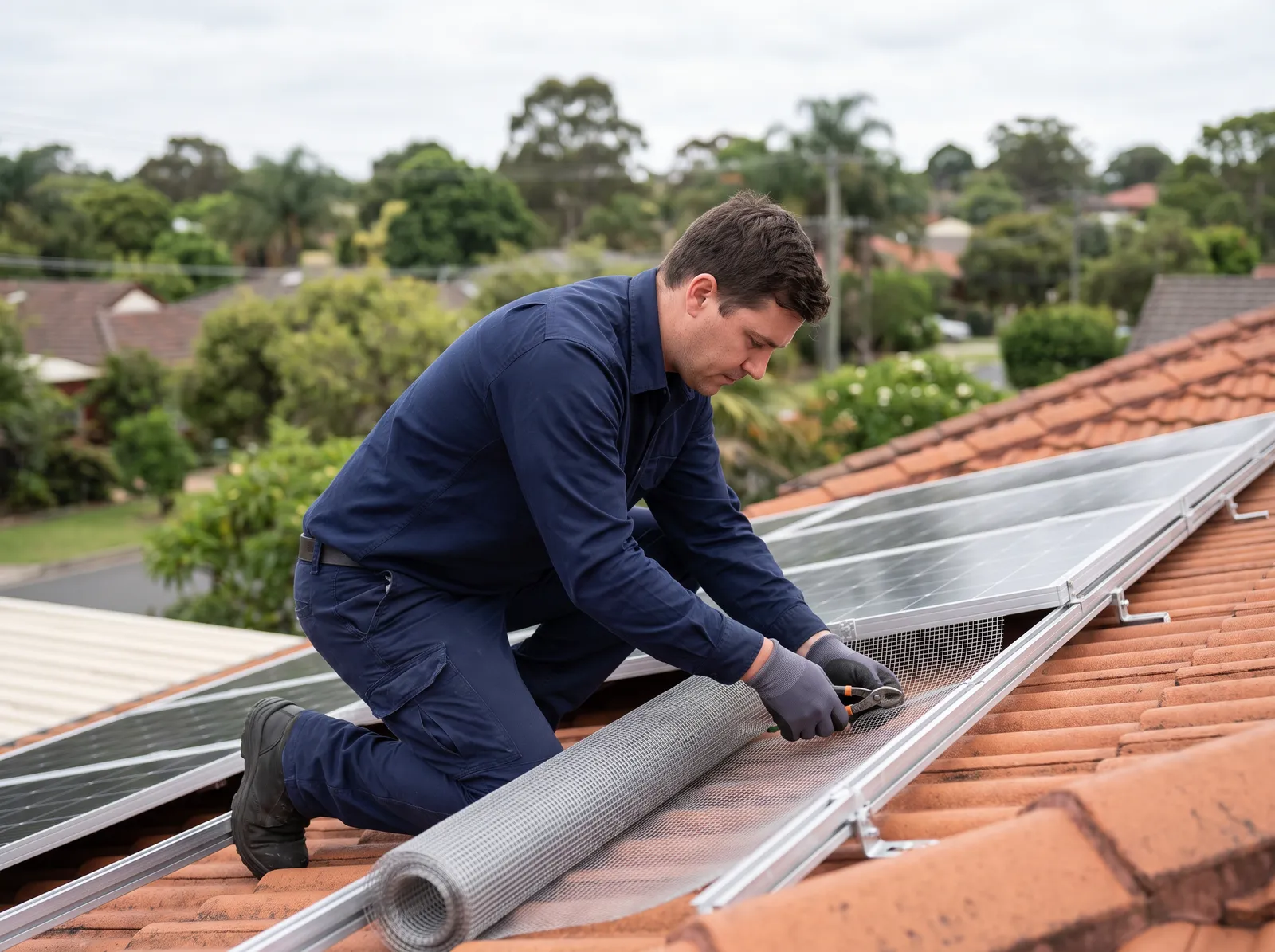
Illustrative photos. Methods described generally; every roof is quoted on what it actually needs.
Pigeons, mynas and starlings
The birds that become a problem in Hunter homes are almost all introduced species: feral pigeons, the common myna, and the common starling. Native birds are protected and stay off-limits, so the honest scope of bird work is proofing the roosts the pest birds have claimed, not clearing the sky.
- Cooing and scuffling under the solar panels
- Feral pigeons love the warm, sheltered gap between panel and tile. It is the single most common bird job we see, and mesh clipped around the array is the fix.
- Droppings streaking a wall or path
- A regular roost above. Beyond the mess, built-up droppings are a genuine health matter, which is why a clean-down is part of the work, not an extra.
- A noisy, bold brown bird with a yellow eye-patch
- The common myna, an introduced pest that muscles native birds out of nesting hollows. Proofing its roosts is legitimate; it is not a protected native.
- Nesting racket in the eaves or a wall vent
- Starlings and sparrows pushing into gaps. The gap gets meshed once any nest is clear, so timing matters in spring.
The honest fine print
We proof, we do not exterminate. Possums and native birds are protected, and we would not harm them even if the law allowed it. The whole method is to make your roof unavailable and give the animal somewhere else to go.
Spring is nesting season. A gap with a working nest and dependent young in it does not get sealed until the young have fledged and moved on. It is both the law for native birds and the only decent thing to do, and it can shift the timing of a job by a few weeks.
Solar panels are their own trade now. If pigeons have moved in under a panel array, the mesh has to fit without voiding the panel warranty or blocking airflow, which is why it is fitted around the frame, not jammed under it.
If it turns out to be a rat, we will say so. A fair share of "possum" callouts are rodents once we hear the detail. If that is what the roof holds, we point you to rodent control rather than sell you the wrong job.
Asked at the eaves
There is a possum in my roof. Can you just take it away?
Not lawfully, and it would not help if we could. NSW rules require a trapped possum to be released on the same property, close to where it was caught. The job that actually works is proofing the roof so it cannot get back in, and giving it a nest box to move into instead.
How do I know it is a possum and not a rat?
Weight and timing. A possum is a heavy, slow thump around dusk and dawn, often with a deep hiss. A rat is a light, fast scurry through the middle of the night. If you are unsure, tell us what you hear and when, and we will settle it before booking.
Do you kill the possum?
No. It is protected, and poisoning or harming it is against the law. Proofing works with the animal's own habits, waiting for it to leave and then closing the door behind it, so it moves to the alternative rather than being harmed.
Pigeons have nested under my solar panels. Can you clear them?
Yes. That is the most common bird job we do. Fine mesh is fitted around the edge of the panels so birds cannot get into the gap, the area is cleaned down, and the roost is gone without touching the panels' performance.
Can you get rid of the noisy birds in my yard?
It depends what they are. Introduced pests like pigeons, mynas and starlings can be proofed off their roosts and nesting spots. Native birds are protected and off-limits, so we are honest up front about what can and cannot be done.
- NSW Environment and Heritage, Possum catch and release licences. The protected status, the release-on-the-same-property rule, and the advice to permanently seal roof entrances that this page describes.
- Australian Museum, Common brushtail possum. Reference identification for the Hunter's usual roof possum, including the habits behind the dusk-and-dawn thump.
- NSW Environment and Heritage, Deterring Indian mynas. The introduced-pest status behind proofing myna roosts while native birds stay protected.

Tell us what you have seen
A description and a suburb is enough. A licensed technician reads every enquiry, works out what the job needs, and comes back with a straight answer and a free quote. No obligation, no pressure.