
Ant control in Newcastle and the Hunter
A line of ants across the bench, a trail that vanishes into a wall, fine soil pushed up between the pavers, or winged ants swarming after rain. This page tells you which ant you are looking at, what it is doing, and why the fix is baiting the colony rather than wiping the trail you can see.
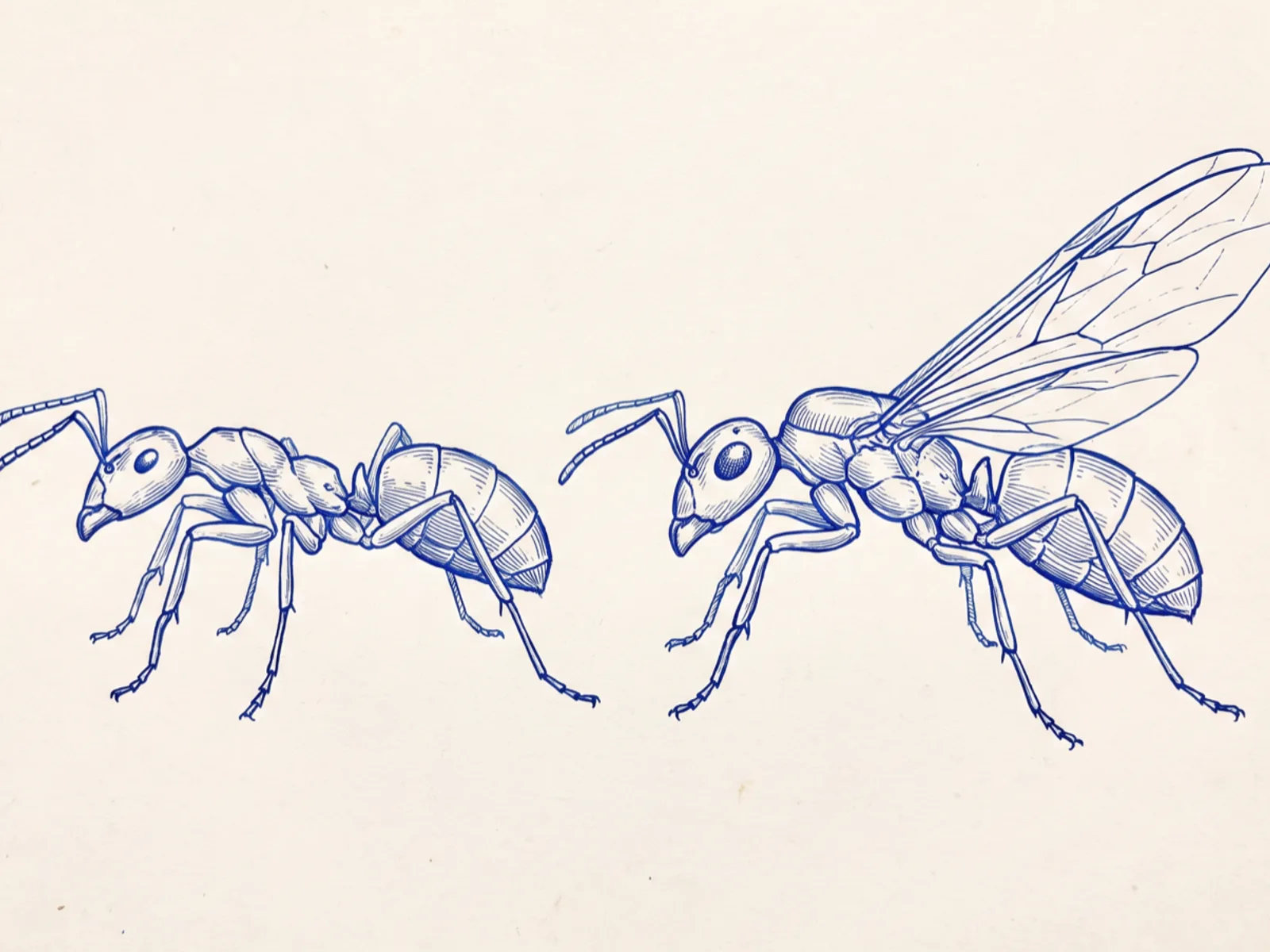

Winged insects after rain: ant or termite?
A warm, humid evening after rain is when both flying ants and termites leave the nest to mate, so a swarm around the lights is the one ant sighting worth slowing down for. They are easy to tell apart once you know the three marks, and the difference matters: flying ants are a nuisance, termite alates near a house are a reason to book an inspection today.
Caught one on the windowsill? Keep it. A single specimen settles the question in seconds, and the flying ants or termites guide walks the same check with pictures.
The sign you actually saw
- A trail across the bench or floor
- The classic. A steady two-way line of small dark ants between a food source and a gap in the wall or skirting. The trail is a scent road; the ants on it are foragers, a small fraction of a colony that can run to thousands out of sight.
- A trail that disappears into a gap
- Follow it and it ends at a weep hole, a skirting join, the slab edge or a wall cavity. That gap is the front door of the nest, and it is where the treatment has to reach, not the benchtop.
- Fine soil pushed up between pavers
- Little mounds of loose sandy soil in the joints of a paved courtyard, path or driveway. That is the coastal brown ant excavating its nest underneath. Cosmetic mostly, but it comes back until the colony under the paving is dealt with.
- Winged ants indoors, or a swarm outside
- The colony sending out next year's queens. Harmless in themselves, but worth the five-second check above before you assume, because termite alates swarm the same nights.
- Tiny ants versus big ones
- The little ones raiding the kitchen are usually black house or coastal brown ants; the big slow ones on the path at night are sugar ants, mostly nesting outdoors. Different ants, different baits, which is why naming them comes first.
- Ants that appear overnight after rain
- Heavy rain floods nests in the soil and pushes the colony to forage indoors where it is dry. A sudden invasion the morning after a downpour is weather, not a new problem, and it settles differently to a year-round trail.
What they are doing in a Hunter house
Ants read a house as a landscape of food, water and cavities, and the Hunter offers all three in abundance. The trail on your bench is one supply line out of a nest you rarely see: inside a wall cavity, below the slab edge, under the pavers, or in the garden bed built up against the wall. Treating the bench moves the trail; it does not move the nest.
On the paved courtyards and brick driveways so common here, the coastal brown ant nests in the sand bed under the pavers and pushes the spoil up through the joints. It is a coastal specialist, and the salt-band suburbs with their sandy soils suit it. Indoors, the black house ant works the cavities and roof voids of the older weatherboard and Federation stock, following pipes and cables from the wall into the kitchen.
Rain sets the calendar. A wet spell floods soil nests and drives foraging indoors for days afterwards, which is why the worst ant weeks follow the worst rain. Warm, humid evenings after that rain trigger the nuptial flight, the winged ants at the lights. And a garden mulched hard against the wall, or a branch touching the eaves, is a bridge the colony will find and use.
Bait the colony, not the trail
A can of surface spray kills the ants you can see and feels like a result. A day later the trail is back, because the colony that made it never left. Lasting ant control works the other way around, in three steps.
Find the nest and name the ant
We follow the trails back to where they enter and work out the species, because the ant decides the bait. A coastal brown ant, an Argentine ant and a sugar ant each go for a different bait in a different spot. Guessing wastes the visit; identifying does not.
Bait so the workers carry it home
The right gel or granular bait is taken as food, shared through the colony and reaches the queen, which is the only part of an ant that matters. It looks slower than a spray for a day or two and then the whole trail is gone, not just the ants that were on the bench.
Treat the perimeter and proof the entries
Once the colony is down, a perimeter treatment and sealing the actual entry points keeps the next lot out, and we point out the conducive conditions worth fixing: mulch pulled back off the wall, the branch trimmed off the eaves, the gap around the pipe sealed.
Illustrative photo. Methods described generically; every job is quoted on what your house and your ant need.
The honest fine print
Supermarket spray can make it worse. Some of our common ants, the Argentine and the coastal brown among them, respond to a repellent spray by splitting the colony into several. You knock the trail down and a fortnight later there are three of them. It is the single most common reason a DIY ant job goes backwards, and the reason baiting is the professional default.
Ants in your wall are not eating it. Unlike termites, ants do not damage sound timber; where they nest in wood they are using a gap that was already there. Real damage is a termite question, not an ant one. The exception that earns a phone-down moment is winged ants after rain: run the check above, and if you cannot be sure, treat them as termites and book an inspection.
One visit or a season program. A single indoor trail is often one treatment. A coastal block that gets ants under the pavers every spring is better on an annual perimeter, timed before the season starts. We quote per treatment or as a program, and we tell you which your place actually needs rather than defaulting to the bigger one.
Sometimes the nest is not yours. Ants cross boundaries, and a colony under next door's paving or deep in a shared slab can keep re-supplying your kitchen. Where that is what we find, we will say so plainly and treat what we honestly can.
Asked every summer
Why do the ants come straight back after I spray?
Because the spray only reached the foragers on the trail, and the nest is untouched. The colony simply sends more along a new scent line. Baiting works because the workers carry it home to the queen, so the source goes, not just the symptom.
I have winged ants after the rain. Are they termites?
Maybe, and it is worth thirty seconds to be sure. Flying ants have a pinched waist, bent antennae and a longer front pair of wings; termite alates have no waist, straight antennae and two pairs of equal pale wings. If you cannot tell, treat them as termites: do not disturb them and book an inspection. The flying ants or termites guide has the pictures.
Ants are lifting my pavers and getting in the driveway joints. Can you fix that?
Yes. Mounds of fine soil between pavers are usually coastal brown ants nesting in the sand bed underneath. We bait and treat the colony under the paving rather than sweeping the spoil, which is the part that keeps coming back if you only clean it up.
Are ant baits safe around pets and kids?
Handled properly, they are placed as small amounts in cracks, corners and stations out of reach, not spread across open floors. Tell us about the dog, the cat and the toddler in the enquiry and the placement is built around them. There is no blanket "safe" product, so the honest answer is about how and where, not a label claim.
Do you treat inside, outside, or both?
It follows the nest. A kitchen trail from a wall cavity is treated at the entry and inside; a paver or garden colony is treated outdoors at the source with the perimeter proofed. Most jobs touch both, because the ants you see inside almost always live outside.
It is only a few ants. Do I really need a professional?
Often not, and we will say so. A stray scout or a one-off trail to a spill can be wiped up and forgotten. It is worth a call when the trail keeps returning, when there are mounds in the paving, or when you are seeing winged ants near the house, because those are colony signs, not stray ants.
- Australian Museum, What are the differences between ants and termites?. The reference for the five-second check above: waist, antennae and wing marks that separate a flying ant from a termite alate.
- Australian Museum, Ants as pests. On why ants enter buildings, where they nest, and the fact that ants in timber use existing cavities rather than eating sound wood.
- NSW EPA, Pesticides licences. Ant treatment around a home is licensed pesticide use in NSW; this is the scheme that governs pest management technicians.

Tell us what you have seen
A description and a suburb is enough. A licensed technician reads every enquiry, works out what the job needs, and comes back with a straight answer and a free quote. No obligation, no pressure.